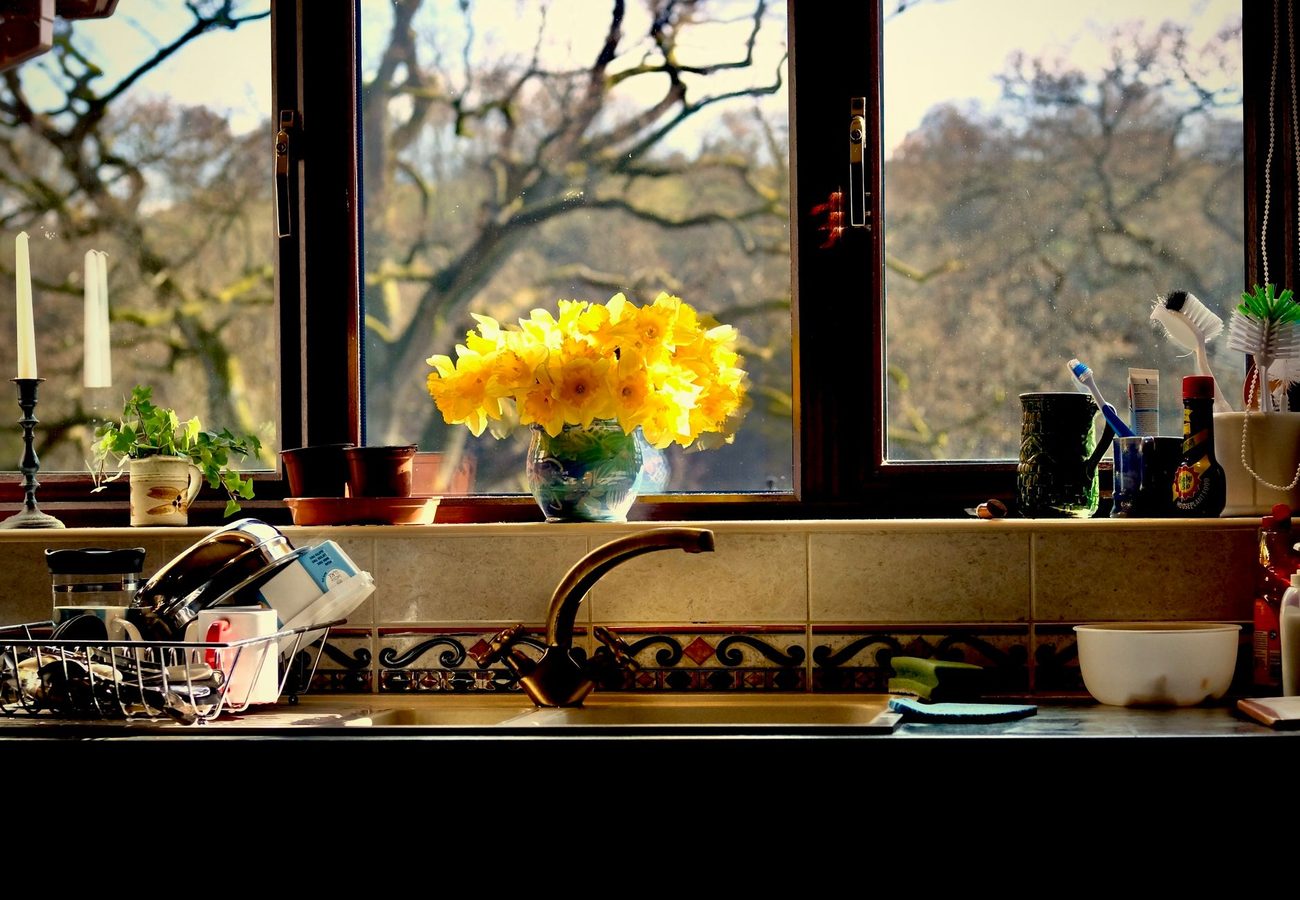
At 10:20 on Tuesday night, Tessa filled the kettle and the cold tap gave her a thin, wobbling stream, like a garden hose someone was standing on. The hot side ran fine. Outside it was already a few degrees below zero on its way to the forecast low of minus six, the coldest night of the winter so far.
"Is this the pipe you replaced?" she asked.
"Yes."
"So it's your pipe."
It was my pipe. Last July, Gary and I replaced the last 1952 galvanized run to the kitchen with PEX over the Fourth of July weekend. The kitchen sink sits on the exterior back wall of the Cape, and that line runs up from the basement through the floor right next to the dishwasher. That's the coldest corner of the kitchen, and it's exactly where I'd been lazy.
The first hour
We did these things, more or less in this order:
- Opened both doors on the sink cabinet so room air could get into the base.
- Left the cold tap open to a steady trickle. Moving water is a lot harder to freeze than still water.
- Overrode the thermostat. Our schedule drops to 63 at night, and I put it on a hold at 67 until morning.
- Went down to the basement with a flashlight to find where the cold was getting in.
It didn't take long. The PEX comes off the copper main, runs along the joists toward the back wall and turns up through the subfloor near the rim joist behind the dishwasher. That bay was bare wood. The sill plate was cold enough to sting my hand, and the pipe ran within a few inches of it.
I got Tessa's hair dryer, set it on low and aimed it at the PEX where it ran closest to the rim, moving it back and forth the whole time and never holding it in one spot. No torch, no space heater wedged in next to the wood. After about twenty minutes, Tessa yelled down the stairs that the tap was running normally. I kept going for another five minutes because I didn't trust it.
We left the cabinet doors open and the trickle running overnight. I set an alarm for 3 a.m. to check. It was fine. Moose, who normally saves his night barking for the city plow, followed me to the kitchen and back with great suspicion.
The bay I skipped
In October I spent a weekend and $310 putting fire-rated foam board on the rim joists around the whole basement. Every bay got a cut piece of board with the edges sealed with canned foam. Every bay but one.
The bay behind the dishwasher was the last one on Sunday evening. The kitchen line comes up through it, along with the drain and a cable, and cutting a board to fit around all of that was fiddly. I was tired, I told myself I'd come back to it, and I didn't. Every other bay in the basement got insulation, and the one I skipped was right next to the most important pipe in the kitchen. If I'd put it on a list, I would have finished it. I wrote COME BACK on the joist instead, where nobody, including me, ever looked again.
On Wednesday night I fixed it. I had leftover board from October, so I cut two pieces with a utility knife, notched them around the PEX and the cable and fit them into the bay. The foam gun from October still had a usable can on it, and it sealed the edges and the gaps around the pipe. Then I wrapped the exposed PEX near the rim with a leftover length of foam pipe insulation from the July job. On Thursday morning the sill plate in that bay felt like the rest of the basement.
PEX is forgiving, but still
One of the reasons we picked PEX in July is that it can stretch a little if water freezes inside it, where old galvanized or copper is more likely to split. That's true as far as it goes. But the crimp fittings, the shutoff valve under the sink and the copper stub where the PEX connects to the main don't stretch. A frozen line can still hurt you at the joints. And with a $2,500 deductible on our policy, a burst pipe behind the dishwasher would have been mostly our money anyway.
Gary came over on Wednesday to look at the new foam and said, "Cold finds the one spot you didn't do." He's right. Our first winter in the Cape, the front hose bib split. Our second winter, the kitchen line came close. I'd like the third winter to be boring.
Trip count: 0. The first time ever, and only because I'd bought everything three months earlier and then didn't use it.