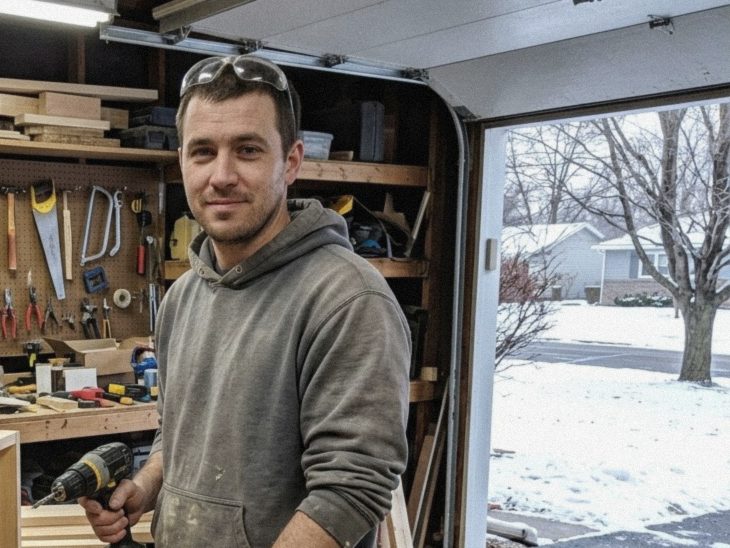
Thirty-four inches. That's how tall I built our new workbench on Saturday, because that was the number on the plan I'd been staring at all week. By Saturday night my lower back had filed a formal complaint, and by Sunday afternoon the bench was 37 inches. More on that in a minute.
One sheet of plywood, a stack of 2x4s
The bench was part of the garage cleanout on our wedding-prep list, and I wanted it simple: an 8-foot top, 30 inches deep, a 2x4 frame and a shelf underneath for everything that currently lives on the floor. One 4-by-8 sheet of 3/4-inch plywood covers both. Rip it lengthwise at 30 inches and you get the top, plus an 18-inch strip that becomes the lower shelf.
Thirty inches deep was a choice, not a default. Tessa's Civic lives in the garage in winter, and the garage is only 20 feet long. I measured the car, then measured the garage twice. Tessa's whole position on this project fit in one sentence: "If my car doesn't fit in December, the bench goes on Marketplace."
The materials came to $186:
- 2x4s: $54
- One sheet of 3/4-inch plywood: $64
- Pocket screws and construction screws: $26
- Wood glue: $6
- A clamp-on power strip for the back edge: $22
- Paste wax for the top: $14
That's before the 11 percent Menards rebate, which went into the kitchen junk drawer with all the others. Two tools I bought for this aren't in that total, because they're logged as tools: a Kreg pocket-hole jig for $40, and a DeWalt 20V circular saw, bare tool, on sale for $139.
I almost bought a $40 corded saw instead. I mentioned it to Gary over the fence, and he said, "Buy once, cry once." The DeWalt runs on the same batteries as my drill and impact, and after one Saturday with it I understand his point.
Saturday: building it
Gary lent me his miter saw, and I had it set up on two sawhorses in the driveway by 7 a.m. Every 2x4 crosscut went through the miter saw, which meant square ends without me having to think about it. The circular saw handled the long plywood rip, guided by a straight piece of scrap clamped to the sheet.
The frame is two rectangles, one for the top and one for the shelf, joined at the corners with pocket screws and glue, with a middle brace in each. The legs are 2x4s screwed to the inside corners of both frames. The top and the shelf screw down from above. Around 11 I ran out of pocket screws and made a second trip, which I'm told is a tradition.
By 4 p.m. it was standing, level and solid. I was very proud of it for about an hour.
Sunday: the height fix
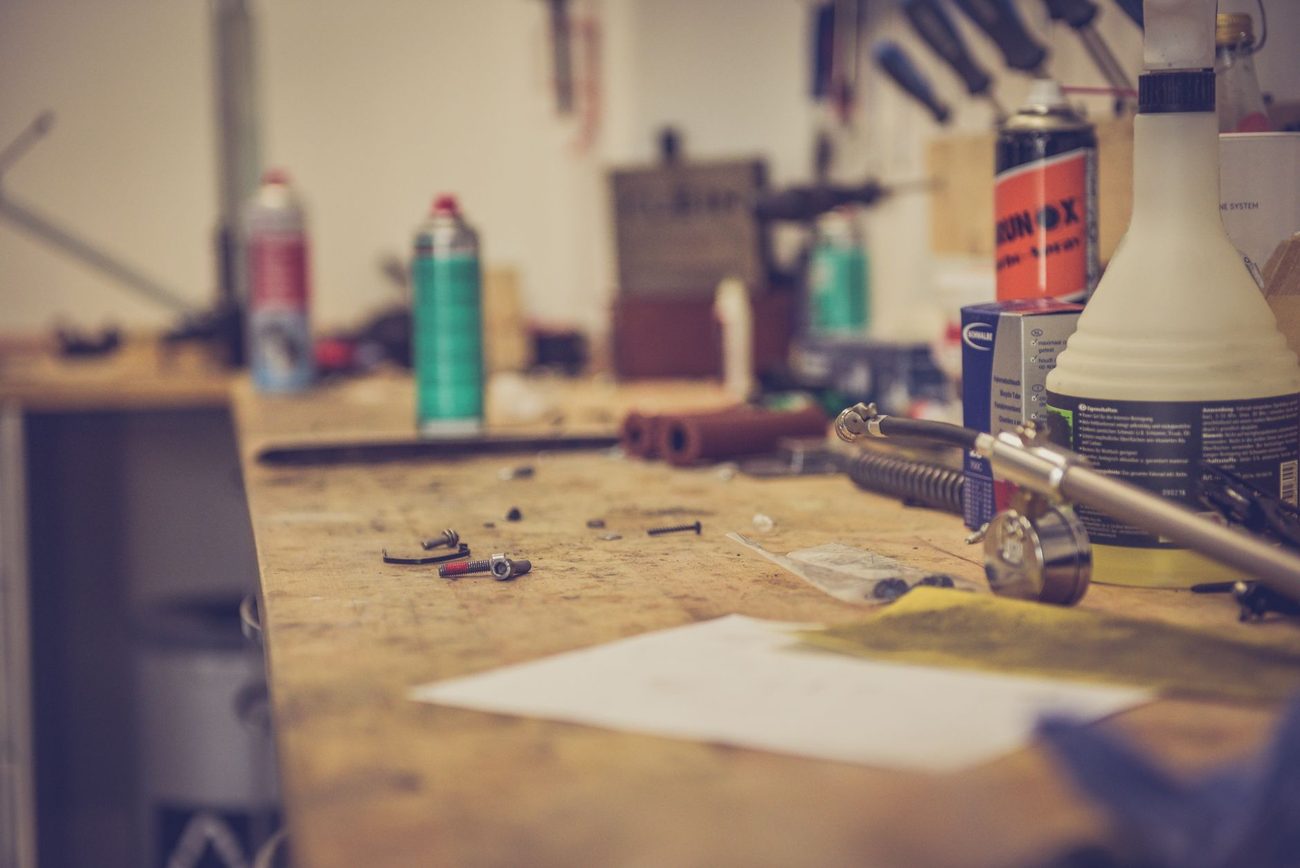
The problem showed up the first time I actually used it. I spent forty minutes sorting screws and fittings on the new top, and by the end I was hunched over like I was reading fine print. Our kitchen counters are 36 inches, and I already lean over those. From what I've read, 34 is a common height for benches where you're planing or hand-sawing, which I don't do. For sorting parts, assembling things and small repairs, I wanted the top closer to my hands.
This is where pocket screws earned their keep. On Sunday morning I backed the screws out of the legs, cut four new legs three inches longer and put it all back together. One more 2x4, an hour and a half of work, and the bench is now 37 inches, which feels right when I stand at it with a cup of coffee and pretend I'm about to do something important.
If I built it again, I'd stand where the bench was going to go, hold my hands where I'd want to work, and have someone measure to the floor before I cut anything. It's the cheapest step in the whole project, and I skipped it because a plan said 34.
The bench now holds the Klein tester, a box of SharkBite fittings left over from spring and a coffee can full of screws I'll sort someday. The power strip on the back edge means the battery chargers finally have a home that isn't the floor.
Trip count: 3.