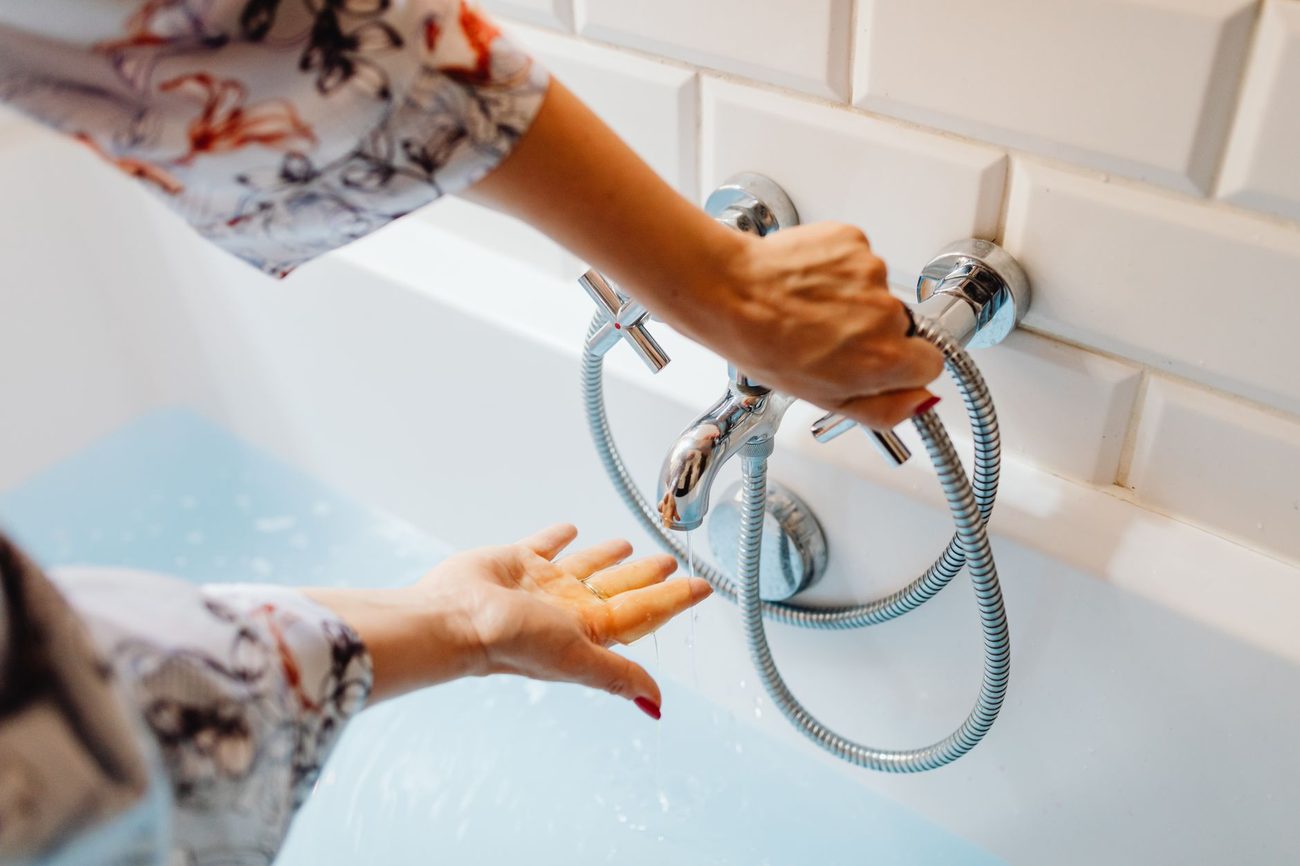
A dripping faucet over a cast-iron tub sounds exactly like someone tapping a spoon on a bell. I know because I went downstairs for a glass of water at 2 a.m. one night in April and ended up standing in the bathroom doorway, counting. Thirty-one drips a minute, all from the hot side.
Our bathroom is the original 1952 one: pink tile with black trim, a cast-iron tub and a two-handle faucet set right into the tile wall. We love the pink. We did not love the drip, which had gone from occasional in March to steady by mid-April. I put a jar under the spout one night and it had about two cups in it by morning.
Getting the old stems out
A two-handle tub faucet has a stem on each side, a threaded brass piece that screws into the valve body behind the wall. When the rubber washer on the end of the stem wears out, or the brass seat it presses against gets pitted, water sneaks past. On our faucet, the stems sit a few inches back inside the wall, so you need a deep tub socket to reach them. Gary had a set in his garage, of course, along with a seat wrench.
I shut off the main valve in the basement, opened the kitchen faucet to drain the lines and put a rag in the tub drain, because I've dropped enough small screws down enough drains. The handles were stuck on with decades of mineral crust. A little heat from Tessa's hair dryer and some gentle rocking got them off without anything touching the tile. Tessa's only instruction before I started was, "If you chip the pink, you're sleeping in the garage."
The stems came out with the socket and a screwdriver through the cross holes for leverage. Both washers were cracked and flattened, and the hot-side seat had a groove worn into it that I could feel with a fingernail. That explained the hot-side drip.
Three stores and a ziploc bag
Here's where a twenty-minute job ate my Saturday. Tub stems are not universal. They differ in length, in thread and in the shape and count of the splines where the handle grips. I put the old hot stem in a ziploc bag, wrote "HOT" on it with a Sharpie and started driving. At work we'd call that a physical sample, and you never place an order without one.
My actual first mistake came a week earlier, before I'd pulled anything apart. I went to Menards with a phone photo of the faucet handle, convinced I could match the stem by eye. I could not. I came home with nothing, which is the most honest thing I can say about that trip.
With the real stem in hand, store one was Menards again, where an entire wall of carded stems somehow didn't include ours. Store two was Home Depot, which had one that matched the splines but ran about half an inch short. Store three was a local Ace, where a man about Gary's age pulled open a drawer of loose stems, held mine up against three of them and said, "This one." He was right. He also reminded me about seats, which I had completely forgotten to look for.
The bill: two stems, two seats, new washers already fitted to the stems and a small tube of plumber's grease. $46 total.
Twenty minutes, then a test
With the right parts, the rebuild really did take twenty minutes. Old seats out with the seat wrench, new seats in with a little grease on the threads, new stems threaded in by hand first so I wouldn't cross-thread them, then snugged with the socket. Snug, not cranked. Brass is soft, and the last thing I wanted was a stripped valve body behind a tile wall I love.
I turned the main back on slowly and wrapped a dry paper towel around each stem. Nothing. Handles and escutcheons went back on, and the faucet now shuts off with less effort than it has since we moved in. The only casualty was my knuckle, which met the tile once on the way out. The tile won and was unharmed.
It's been four nights now and the spoon-on-a-bell sound is gone. The jar is back under the kitchen sink where it belongs, and the old stems are in a labeled bag in the basement, in case the cold side ever needs a match.
Trip count: 4, counting the photo trip. Gary says borrowing from his garage doesn't count.